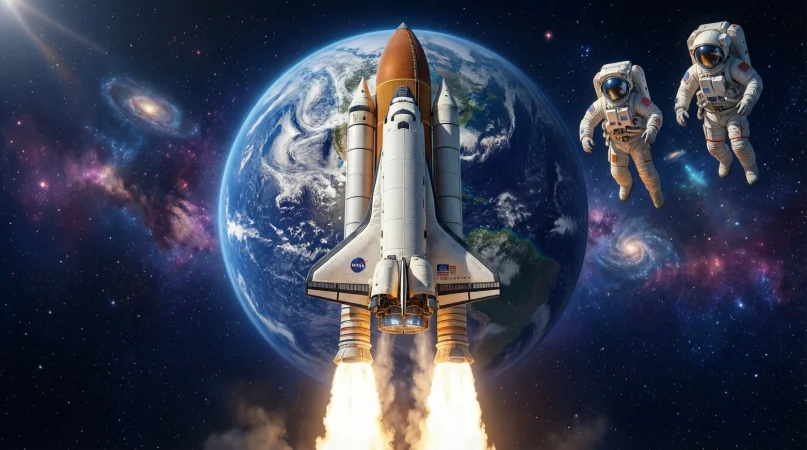
At some point, most of us have heard the name NASA. It shows up in school textbooks, space documentaries, news headlines, and even movies. I remember first hearing it as a kid and thinking it was just another cool science word. But later, a simple question came to mind.
What does NASA actually stand for? If you have ever wondered the same thing, you are not alone. Many people search this term to understand its full meaning and importance.
Quick Answer:
NASA stands for National Aeronautics and Space Administration. It is a United States government agency responsible for space exploration, space science, and aeronautical research.
What Does NASA Stand For in Simple Words?
NASA is the short form of National Aeronautics and Space Administration.
In simple terms, NASA is the organization that studies space, launches rockets, explores planets, and develops advanced space technology for the United States.
Breaking it down:
- National means it represents the country
- Aeronautics relates to aircraft and flight
- Space focuses on outer space research
- Administration means it is a government agency
Example sentence:
NASA launched a new space telescope to explore distant galaxies.
In short:
NASA = National Aeronautics and Space Administration = US space agency
Where Is NASA Commonly Mentioned or Used?
NASA is commonly seen or mentioned in many educational and scientific spaces, including:
- 🚀 Space missions and rocket launches
- 🧑🚀 Astronaut training programs
- 📚 School and university textbooks
- 📰 Science and technology news
- 🎥 Space documentaries and movies
- 🌌 Astronomy and space research discussions
NASA is a formal and official term. It is appropriate for education, professional writing, research papers, and news articles.
Examples of NASA Used in Sentences
A: Did you watch the rocket launch yesterday?
B: Yes, NASA did an amazing job 🚀
A: Who sends astronauts to space?
B: NASA handles most US space missions.
A: I want to work in space science one day.
B: You should aim for NASA 👩🚀
A: Is NASA only about space?
B: No, they also research aircraft and technology.
A: That Mars rover looks impressive.
B: NASA designed it to explore the planet.
When to Use and When Not to Use NASA
When to Use
- In educational content
- In science and space discussions
- In formal writing and research
- In news and documentaries
- When talking about US space missions
When Not to Use
- When referring to space agencies from other countries
- As a casual joke or slang word
- In contexts unrelated to science or space
Context Comparison Table
| Context | Example Phrase | Why It Works |
|---|---|---|
| School Assignment | NASA studies space and aeronautics | Accurate and educational |
| News Article | NASA announces a new moon mission | Professional and factual |
| Casual Chat | NASA launches are always exciting | Informative and natural |
| Fictional Use | NASA saved the world in the movie | Acceptable in entertainment |
Similar Organizations or Related Terms
| Term | Meaning | When to Use |
|---|---|---|
| ESA | European Space Agency | Talking about Europe |
| ISRO | Indian Space Research Organisation | Talking about India |
| SpaceX | Private space company | Commercial space missions |
| Astronaut | Space traveler | Human spaceflight |
| Rocket | Space launch vehicle | Space technology discussions |
| Space Agency | Government space body | General reference |
FAQs
1. What does NASA stand for?
NASA stands for National Aeronautics and Space Administration.
2. Is NASA a government organization?
Yes, NASA is a United States government agency.
3. When was NASA founded?
NASA was established in 1958.
4. What is NASA famous for?
NASA is known for moon landings, Mars missions, satellites, and space research.
5. Does NASA only study space?
No, NASA also conducts aeronautics and aviation research.
6. Can civilians work for NASA?
Yes, scientists, engineers, and researchers can work for NASA.
7. Is NASA involved in Mars exploration?
Yes, NASA has sent multiple rovers and missions to Mars.
Conclusion
NASA is more than just a famous name. It represents decades of scientific discovery, space exploration, and technological advancement. Now that you know what NASA stands for, you can better understand its role in space missions, research, and global science. Whether you see it in a textbook, news headline, or documentary, NASA remains a symbol of human curiosity and innovation.