Have you ever melted ice, torn a piece of paper, or dissolved sugar in water and wondered what actually changes and what stays the same? Many students first hear the statement “mass is conserved during a physical change” in science class and feel unsure about what it truly means. I remember thinking that if something changes shape or form, its mass should change too. But science tells a different story.
This idea is a core principle in physics and chemistry and helps explain how matter behaves in everyday life. Understanding it not only clears exam confusion but also builds a strong foundation for learning laws of conservation in science.
Quick Answer: Saying that mass is conserved during a physical change means the total mass of a substance remains the same even though its shape, size, or state changes.
What Does It Mean to Say That Mass Is Conserved During a Physical Change?
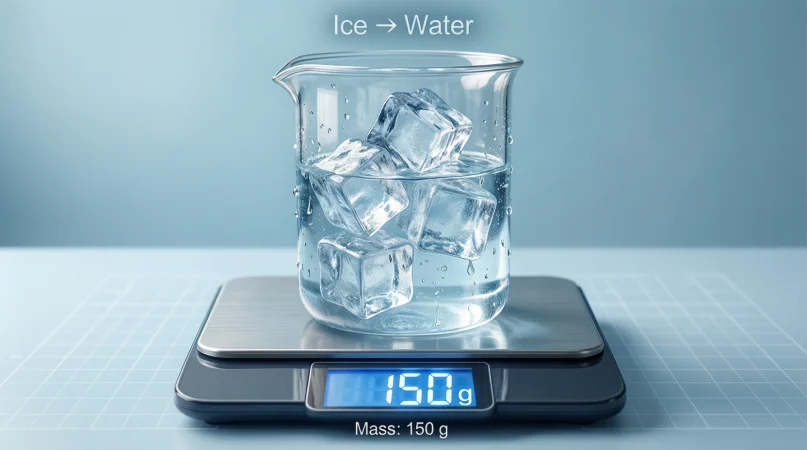
When we say that mass is conserved during a physical change, we mean that no matter is created or destroyed. The substance may look different, but the amount of matter stays constant.
A physical change only affects the form or appearance of matter. Examples include melting, freezing, cutting, crushing, bending, or dissolving. In all these cases, the particles remain the same and only their arrangement changes.
Example:
If you melt 100 grams of ice, you will still have 100 grams of water after melting.
In short:
Mass conserved = same matter before and after the physical change
Where Do We Commonly See Mass Conservation in Physical Changes?
Mass conservation happens in many everyday and scientific situations, such as:
- Melting ice into water
- Freezing water into ice
- Breaking glass into smaller pieces
- Tearing paper
- Dissolving salt or sugar in water
- Stretching rubber
- Evaporation in a closed container
Nature of the concept:
- Scientific and factual
- Used in physics and chemistry
- Common in school and college exams
- Applies to real life observations
Examples of Mass Conservation During Physical Change
A: What happens to mass when ice melts?
B: It stays the same because melting is a physical change.
A: Does tearing paper reduce its mass?
B: No, the mass stays constant.
A: Sugar disappears in water. Is mass lost?
B: No, the sugar is still there, just dissolved.
A: Why does melted wax weigh the same?
B: Because mass is conserved during physical change.
A: Is boiling water a physical change?
B: Yes, and the total mass remains the same if nothing escapes.
When Mass Is Conserved and When It Is Not
✅ When Mass Is Conserved
- During physical changes
- When the substance only changes shape or state
- When no new substance is formed
- When the system is closed
❌ When Mass May Change
- During chemical reactions
- When gases escape from an open system
- When burning or rusting occurs
- When matter reacts to form new substances
Comparison Table
| Situation | Type of Change | What Happens to Mass |
|---|---|---|
| Ice melting | Physical change | Mass remains same |
| Paper tearing | Physical change | Mass remains same |
| Water boiling in open air | Physical change | Apparent mass loss due to vapor escape |
| Burning wood | Chemical change | Mass changes due to new substances |
Similar Scientific Concepts Related to Mass Conservation
| Term | Meaning | Usage |
|---|---|---|
| Conservation of mass | Mass cannot be created or destroyed | Chemistry laws |
| Physical change | Change in form not substance | Basic science |
| Chemical change | New substance formed | Reactions |
| Closed system | Matter cannot escape | Experiments |
| States of matter | Solid liquid gas | Phase changes |
| Matter | Anything with mass and volume | Fundamental concept |
FAQs
1. What does mass conservation mean in simple words?
It means the amount of matter stays the same even if it changes form.
2. Is melting a physical change?
Yes, melting is a physical change and mass is conserved.
3. Why does mass seem to decrease during evaporation?
Mass only appears to decrease because gas escapes into the air.
4. Is mass conserved in chemical changes?
Not always. Chemical changes form new substances.
5. Does dissolving change mass?
No, dissolving is a physical change and mass remains constant.
6. Why is this concept important in science?
It helps explain how matter behaves and supports scientific laws.
7. Is mass conserved in a closed container?
Yes, mass is always conserved in a closed system.
Conclusion
Saying that mass is conserved during a physical change means that matter does not disappear or appear out of nowhere. Even when a substance melts, freezes, breaks, or dissolves, the total mass stays the same. Only the form changes, not the amount of matter.
This principle is a foundation of physics and chemistry and helps students understand larger ideas like conservation laws and matter behavior. Once you grasp this concept, many science topics become much easier to understand.